

Decoding Your Pennsylvania Criminal Complaint: Key Numbers You Need to Know
When you receive a criminal complaint in Pennsylvania it can be intimidating, confusing, and overwhelming. However, the criminal complaint contains the first pieces of critical information that your attorney will need at the initial consultation or shortly thereafter. Knowing what this information means is an essential step toward understanding where your case stands.
Here is a breakdown of the critical fields found at the top of a Pennsylvania criminal complaint form.
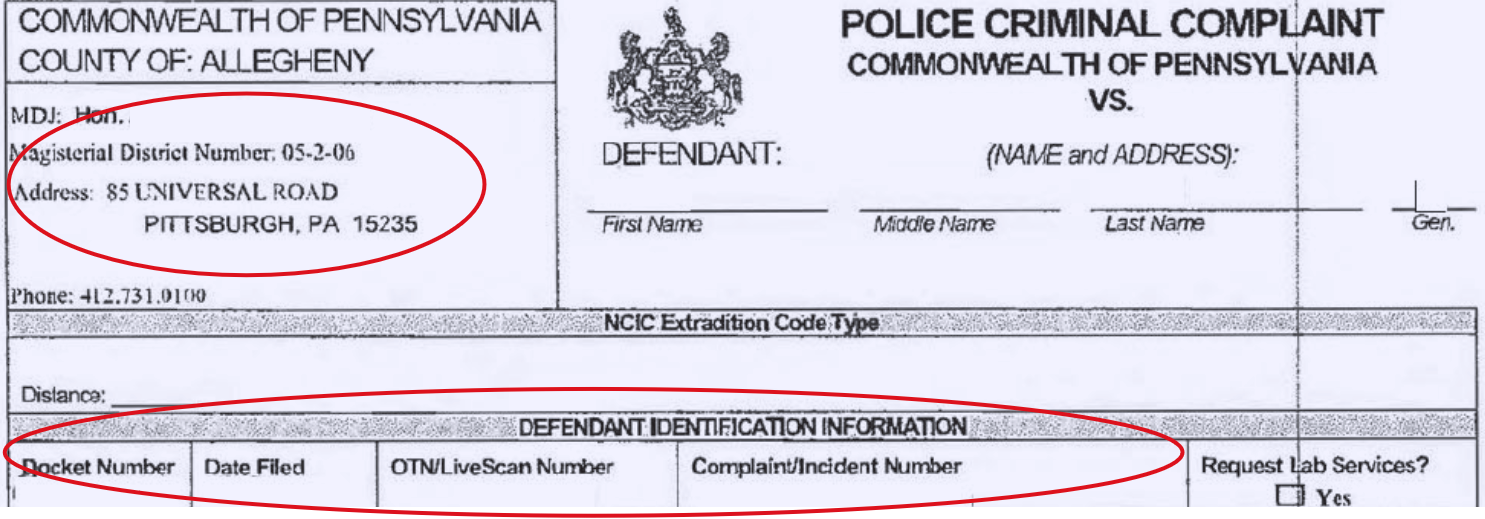
Redacted criminal complaint.
1. The Magisterial Docket Number (e.g., MJ-05206-CR-0000XXX-2026)
Near the top left of the complaint block, you will see a field labeled Docket Number. In Pennsylvania Magisterial District Courts, this number generally follows a standard format (such as MJ-05206-CR-0000XXX-2026). However, on the complaint itself, the number might be handwritten in shortform. Understanding this sequence can tell you exactly where your case is located and what type of case it is:
MJ (Magistrate Docket): The "MJ" indicates that your case is currently at the Magisterial District Court level.
05206 (Magisterial District): This number refers to the specific magistrate district handling your initial hearings. On your physical paperwork, it is usually written with dashes, such as 05-2-06. You can use this district number to look up the exact address and contact information for the magistrate office handling your case by using the official Magisterial District Judges directory provided by the Unified Judicial System of Pennsylvania.
The district code for Pittsburgh Municipal Court is 05-0-03. So if you see this number on your paperwork, your preliminary hearing is probably scheduled at 660 First Avenue, Pittsburgh, PA 15219.
CR (Criminal): The "CR" stands for Criminal. It distinguishes your case from civil disputes, traffic citations, or non-criminal summary violations. You might occassionally see “MD”. This means “Miscelaneous Docket.” If your attorney needs to file a motion before the case proceeds to the formal arraignment at the court of common pleas, it will need to be assigned a separate MD number. This is a holdover from the old days when the court file had to be physically transported from the magistrate office to the clerk of courts office.
0000XXX (The Actual Docket Number): The numbers immediately following the "CR" represent your actual, unique docket number for that specific court.
2026 (The Date/Year): The final four numbers represent the year that the criminal complaint was filed.
On the criminal complaint, you might see the docket handwritten like, “CRXXX26.” But, now you know that this is a shorthand way of writing the full docket number: “MJ-[district number]-CR-[docket number]-[year].
2. The OTN (Offense Tracking Number)
Located next to the docket number is the OTN/LiveScan Number field. OTN stands for Offense Tracking Number.
What It Is: The OTN is a unique tracking sequence generated when your fingerprints are taken during processing or entered into the digital LiveScan system.
A Permanent Case Identifier: The OTN is arguably the most vital tracking number on your paperwork. Unlike your docket number—which will completely change when your case moves from the Magisterial District Court up to the Court of Common Pleas—the OTN will stay with your case permanently.
Finding Your Case Online: Because the OTN remains exactly the same throughout the entire life of your case, it is generally the easiest way to find your court records. If you are looking up your case status online, simply enter your OTN into the Pennsylvania Unified Judicial System Case Search portal. Using the OTN guarantees you are tracking the correct file as it moves through the judicial system.
The OTN appears as [L] XXXXXX-X, where [L] is a letter, and the Xs are numbers.
3. The Court of Common Pleas Docket Number (e.g., CP-02-CR-0000XXX-2026)
If your case moves past the preliminary hearing at the magistrate level, it is transferred to the county court and assigned a new docket number. Here is how that new number breaks down:
CP (Common Pleas): Unlike the "MJ" prefix, this number begins with "CP," which stands for the Court of Common Pleas.
02 (County Code): The next number represents the specific county where the court is located. For example, Allegheny County's designated code is 02. You can find a complete list of Pennsylvania's unique county codes on the Unified Judicial System’s Courts of Common Pleas page.
Note that the county revenue codes are similar, but not identical to codes used for the common pleas judicial districts. This is because some judicial districts include more than one county.
CR (Criminal): Just like at the magistrate level, "CR" stands for Criminal.
0000XXX (The Docket Number) & 2026 (The Year): The numbers after the "CR" represent your actual sequential docket number, followed by the year the case was transferred to the Common Pleas court.
Why the County Code Matters:
It is very common for cases in different counties to have the exact same docket number after the "CR". What distinguishes one case from another is that two-digit county code. Often, court paperwork will just list a shorthand version of the docket number and year, such as "XXX of 2026." While this abbreviation is useful when court staff and attorneys are already familiar with the case, it creates a hurdle when you are hiring new representation. When your lawyer sees your case for the first time, they will need either the specific MJ district number or the CP county code to find your exact file. All of this confusion is eliminated by using the OTN, which uniquely identifies your case no matter where it is.
4. The Complaint / Incident Number
Adjacent to the OTN field, you will see the Complaint/Incident Number.
What It Is: This is an internal administrative reference number created by the arresting police department or law enforcement agency investigating the alleged incident.
Why It’s Less Important for Court: While this number is useful for police record-keeping and for requesting discovery items like police reports or body camera footage, it is generally not important for the court case itself. The judicial system tracks your matter using the docket numbers and the OTN.
5. The Filing Date (And Why It Matters for Rule 600)
Located at the top of the grid is the Date Filed.
What It Is: This is the exact calendar date the police officer or affiant officially filed the criminal charges with the Magisterial District Judge.
Why It Is Critical (Rule 600): The filing date is one of the most critical pieces of information on your paperwork because it officially starts the clock for PA Rule 600—Pennsylvania’s prompt trial rule. Under Rule 600, the Commonwealth generally has 365 days from the date the criminal complaint is filed to bring a defendant to trial (minus any delay legally attributable to the defense). If the prosecution exceeds this timeframe without valid justification, your attorney can file a motion to dismiss all charges with prejudice.
What Should You Do Next?
Understanding your paperwork is a helpful starting point, but navigating criminal charges requires experienced legal guidance. A single oversight early in the process can negatively affect your bail conditions, preliminary hearing strategy, and overall outcome.
If you or a loved one are facing criminal charges in Pennsylvania, do not navigate the system alone. Contact Attorney Aaron Sontz today to schedule a confidential consultation and review your paperwork with a dedicated criminal defense attorney.